
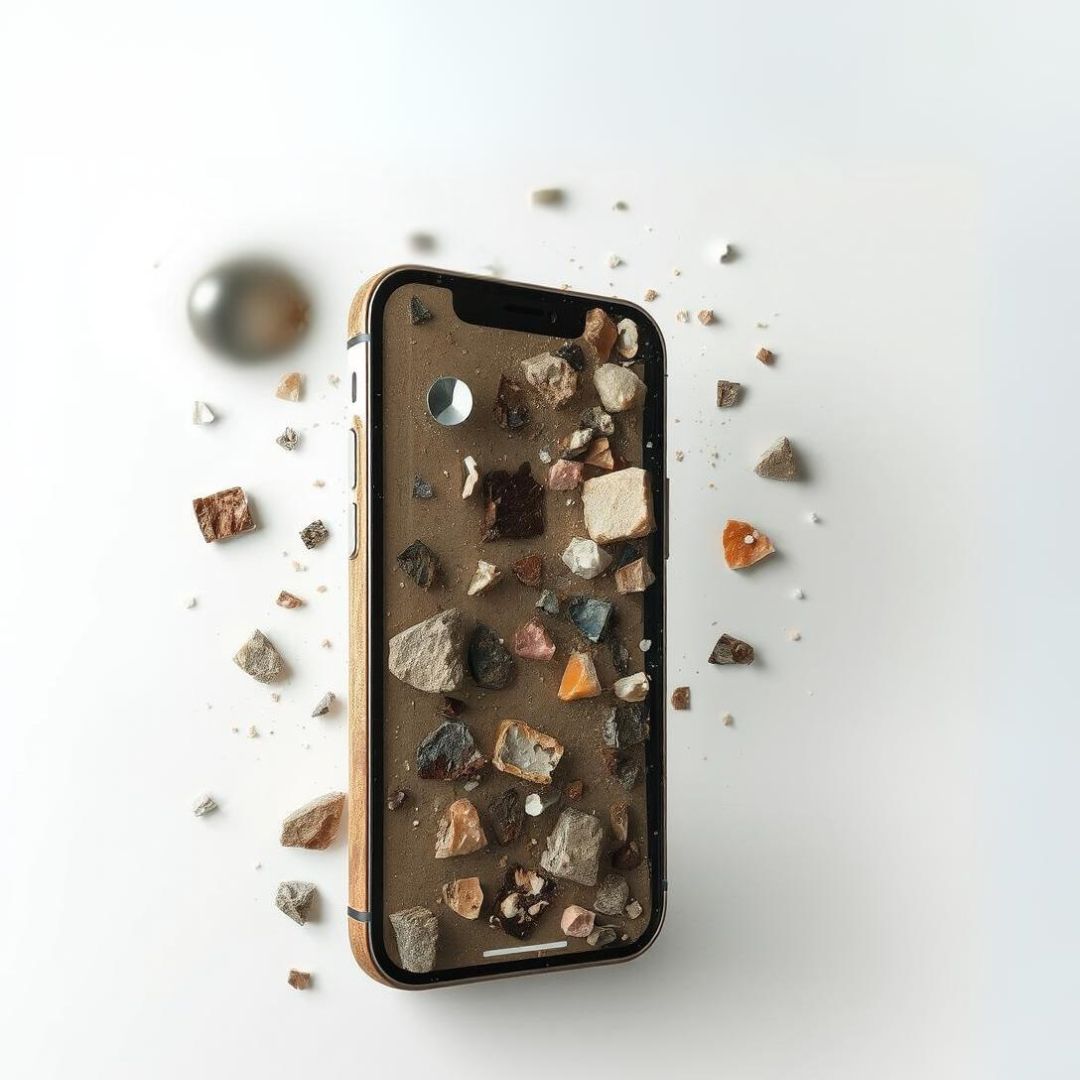
With the latest release of the iPhone 16, do you ever wonder, “What is hiding inside our phones?”
We all love the feel of our mobile phones in the palms of our hands, as the sleek device is always attached to our hips. Such is the case for all phone users, with iPhone users being no exception.
In this article, we will take a deep dive into the behind-the-scenes of our beloved screens.
A Metal Mine in Your Pocket
Name one metal off the top of your head. Did you guess Steel? Or maybe Aluminum? Perhaps you went wild: Gold, Silver, Copper. Your phone contains all the previously listed metals, as well as additional materials such as tin, Platinum, Cobalt, Lithium, Palladium, Silicon, Tungsten, Glass, and even Sapphire. The list is already beginning to resemble the Periodic Table of Elements, but it’s already excluding plastic and the Rare Earth Elements used.
Rare Earth Elements (REEs): The Hidden Gems of Your Phone
Are you reading this article on a phone (or a tablet or laptop). If you answer yes, you’re holding a slice of the Earth’s crust. Yes, that sleek device clutched in your hands right now is packed with 30 different elements that have been excavated, processed, and assembled from mines scattered across the globe.
Beyond the usual metals like aluminum, copper, lithium, and even a little bit of gold, we also have some of the world’s most hard-to-pronounce substances, called rare earth elements (REEs).


Ever heard of lanthanum, neodymium, or dysprosium? Likely not. But I bet you have heard of the products that they are used in. In Tesla’s electric cars, rare earths power magnets used to drive the vehicle; in ChatGPT, REE-powered components form the backbones of the high-performance computational infrastructure; in iPhones, these metals perform the everyday miracles: lanthanum brings the vibrant colors onto your screen, while neodymium and dysprosium give your phone the buzz to wake you up on time. Their magnetic and conductive properties are what make our devices have their high-tech edge.
Despite their superpowers, extracting REEs is a complex process that significantly harms the environment. REEs are typically found in low concentrations within the Earth’s crust, meaning cast amounts of the ore have to be mined to extract a small amount. Often, they come bundled with other elements, and separating them requires lots of energy. Additionally, REEs often coexist with toxic or even radioactive elements, which adds extra hazards to the extraction process.


Environmental Nightmare of Bayan Obo
Consider Bayan Obo, an industrial mining town in Inner Mongolia, China. Active since the 1960s, this town houses the world’s largest REE mineral deposit. In 2019 alone, Bayan Obo was responsible for around 45% of the world’s REE production. However, the environmental cost is staggering. Decades of mining have contaminated local soil and water with heavy metals, arsenic, and fluorine, poisoning the surrounding ecosystems and even the local water source – the Yellow River watershed. Nearly 200 million people rely on this watershed for drinking, agriculture, and industry. This grim reality is a reminder for us: the technology we take for granted comes with unseen costs.
Waste & your response
Consider this: 1 million mobile phones can yield nearly 16 tons of copper, 350kg of silver, 34kg of gold, and 15kg of palladium. Approximately 5.3 million phones are discarded every year, equivalent to an astounding 927,500 tons of mobile phones.
Here is a thought experiment: 1 ton of iPhones can yield 300 times more gold than a ton of gold ore. 1 ton of phones contains 6.5 times more silver than 1 ton of silver ore. Just how much metal was lost to landfills last year alone?


While there may be ways to harvest the metals in all this e-waste, it is rarely safe, economical, ethical and environmentally-friendly. Thankfully, companies like Apple are stepping up. For instance, the iPhone 16 boasts over 30% recycled or renewable content—a step in the right direction.
You’d be right of course. However, the ultimate direction on everyone’s part would be applying the 5 Rs.
While systemic change on a macro level takes time, individual choices can make a difference. Instead of chasing every new release, hold onto your current phone for as long as possible. Most CO2 emissions from phones occur during manufacturing, so extending a device’s lifespan significantly reduces its carbon footprint.
Adopt the 5 Rs—Refuse, Reduce, Reuse, Repurpose, Recycle—and start with the simplest action: resist the urge to upgrade for the sake of trends. After all, sustainability starts with small, intentional steps.
Your phone may be a technological marvel, but let’s not forget the human and environmental cost of what lies beneath its screen.
Discover the hidden journey of your iPhone here:
For the full post, head over to our Instagram page ! 🚀
Don’t forget to like, comment, and share for more behind-the-scenes insights into the items we use every day. 🌍 Stay tuned for more engaging content that breaks down the world around us—one post at a time! 📲✨


Leave a Reply